Calculus II, Spring 2024.
A undergraduate course in Mathematics at the
Department of Mathematics,
National Tsing Hua University.
Instructor:
Professor Wei-Cheng Wang (王偉成).
Office Hours:
T,R: 12:00-13:00 綜三721, 分機62231
or
Google meet by
Email appointment.
Teaching Assistant:
- 林明駿, 綜三207, 分機33036. Office hour: Mon 17:00-18:00. Email: lmj111021513@gapp.nthu.edu.tw
Lecture:
MXIC building (旺宏館), classroom 243, T3T4R3R4.
Recitation:
General III building (綜三館), classroom 201. Thursdays 19:00-21:00.
Grading:
40% quiz(pick n-2 best from n quizzes)+attendance (36%+4%),
20% midterm I, 20% midterm II + 20% final exam.
Extra credits for significant contributions to the class
(correcting mistakes, etc.).
Textbook:
G. B. Thomas, M. D. Weir and J. R. Hass:
Thomas's Calculus Early Transcendentals, 13th edition in SI units
(華通書局有販售,詳見校務資訊系統課程大綱).
Contents:
- Calculus II:
- Chap 10: Infinite Sequences and Series.
- Chap 14: Partial Derivatives.
- Chap 15: Multiple Integrals.
- Chap 16: Integration in Vector Fields.
Syllabus, study guide and exam solutions:
- Calculus II:
- Syllabus (new, revised Mar 22).
- quiz 01 (section 8.8 part I) study guide (updated).
- quiz 02 (section 8.8 (part II), 10.1, 10.2) study guide.
- quiz 03 (section 10.3, 10.4, 10.5) study guide.
- quiz 04 (section 10.6, 10.7 part I ) study guide.
- quiz 05 (section 10.7 part II, 10.8 ) study guide.
- Midterm 01 (section 8.8, 10.1-10.10 ) study guide.
Midterm 01.
- quiz 06 (section 14.2) study guide.
- quiz 07 (section 14.3) study guide.
- quiz 08 (section 14.4, 14.5) study guide (updated, add details to item 2).
- quiz 09 (section 14.6, 14.7) study guide (updated, item 5 revised).
- Midterm 02 (section 14.2-14.9 + midterm 01 contents) study guide.
Remark on definition of differentiability
Midterm 02.
- quiz 10 (section 14.10, 15.1-15.2) study guide.
- quiz 11 (section 15.4-15.5) study guide.
- quiz 12 (section 15.7-15.8) study guide.
- Final Exam (section 14.10-16.3) study guide.
Final Exam.
Lecture notes, homework assignments and solutions:
- Homework policy.
- Week 01:
Lecture 01 (20240220, 85 mins)
Section 8.8: Definition of improper integrals, type I and type II and examples.
Direct computation to find out convergence and divergence.
Integrals ∫01 x-p dx
and ∫1∞ x-p dx
and related integrals.
Lecture 02 (20240222, 75 mins)
Section 8.8: Direct Comparison Test (Theorem 2).
Limit Comparison Test (Theorem 3). Examples.
Homework 01 (lectures 01).
Homework 01 solutions.
Homework 02 (lectures 02-03) (updated with section 10.2).
Homework 02 solutions.
- Week 02: Quiz 01 on Lecture 01 (Feb 27, 10:10AM).
Lecture 03 (20240227, 75 mins)
Section 10.1:
Definition of limit of sequences, including the limit = +- ∞ cases.
Find limit of a sequence using the Sandwich Theorem and L’Hôpital’s Rule.
Section 10.2: Infinite series, definition and example of convergent and divergent series.
Geometric Series, telescoping sum. The n-th term test and its proof.
Examples of divergent series.
Lecture 04 (20240229, 75 mins)
Section 10.3: The integral test and Remainder estimate, Proof and examples.
Section 10.4: Direct comparison test; Limit comparison test.
Examples for both Direct and Limit comparison tests.
Homework 03 (lectures 04-05).
Homework 03 solutions (page 4 corrected).
- Week 03: Quiz 02 (Section 8.8, 10.1, 10.2; Mar 05, 10:10AM).
Lecture 05 (20240305, 65 mins)
Section 10.4: More examples of Direct and Limit comparison tests.
Section 10.5: The Absolute Convergence Test and proof.
Ratio test and Root test. Examples of both tests.
Lecture 06 (20240307, 100 mins)
Section 10.5: Proof of the Ratio Test.
Section 10.6: Definition of Conditional convergence and Absolute convergence;
The Alternating Series Test (Leibniz Test) and remainder estimate; Examples
and proof.
Section 10.7: Definition and examples of power series,
including geometric series; Examples of power series whose radius of convergence
is finite, zero and ∞, respectively.
Homework 04 (lectures 06-07).
Homework 04 solutions.
- Week 04: Quiz 03 (Section 10.3, 10.4, 10.5: Mar 12, 10:10AM).
Lecture 07 (20240312, 50 mins)
Section 10.7: Definition and examples of power series, including geometric series;
The convergence Theorem for power series (Theorem 10) and proof;
Definition of the "radius of convergence"
and the "interval of convergence";
Finding radius of convergence using ratio and root test;
Examples of convergence/divergence when |x-a| = R.
Section 10.7:
Algebraic manipulation of power series: addition, subtraction, multiplication,
Lecture 08 (20240314, 90 mins)
Section 10.7: Algebraic manipulation of power series:
Division: find the power series of A(x)/B(x) by long division.
Remark on radius of convergence of A(x)/B(x).
Term by term differentiation and integration and application.
Homework 05 (lectures 08-09)
(New: updated with Theorem A typed in) (Newer: add update on Hint for Section 10.8, Problem 35, Method 2).
Homework 05 solutions.
- Week 05: Quiz 04 (Section 10.6, 10.7 (part I): Mar 19, 10:10AM).
Lecture 09 (20240319, 70 mins)
Section 10.8: Taylor and MacLaurin series.
Definition of Tf,a(x).
Examples on how to find Tf,a(x) with f(x)= ex, cos(x), sin(x).
Theorem A: How to find Tf,a(x) if
f already has a power series representation (Example: f(x)=1/(1-x)).
Lecture 10 (20240321, 90 mins)
Section 10.8: Example of Tf,a(x) ≠ f(x) except at x=a.
Section 10.9: Taylor's Theorem (Taylor's formula) and proof;
Corollary on how to check whether Tf,a(x) = f(x) from the remainder term
in Taylor's formula;
Sufficient condition on estimates of the remainder term in Taylor's formula;
Examples of "Tf,a(x) = f(x)" for f(x)= ex, cos(x), sin(x);
Examples of finding Tf,a(x) using Theorem A. <
Homework 06 (lectures 10-12)
Homework 06 solutions.
- Week 06: Quiz 05 (Section 10.7 (part II), 10.8: Mar 26, 10:10AM).
Lecture 11 (20240326, 60 mins)
Section 10.10: Binomial series. Application to Taylor series generated by sin-1(x).
Leibniz's formula for π;
Remark on variants of geometric series expansion (binomial series with m=-1);
Applications to evaluation of non-elementary integrals and intermediate forms.
Lecture 12 (20240328, 60 mins)
Section 10.10: More applications
to evaluation of non-elementary integrals and intermediate forms.
Finding the sum of a power series by identifying it with the Taylor series of
basic functions.
Euler identity of exp(iθ).
- Week 07: Midterm 01 (Section 8.8, 10.1-10.10: Apr 02, 10:10AM).
- Week 08: No quiz this week.
Lecture 13 (20240409, 90 mins)
Section 14.2:
Definition of lim(x,y)→(x0,y0) f(x,y) using ε and δ.
Definition of continuity.
Elementary examples of finding lim(x,y)→(x0,y0) f(x,y).
Several examples of lim(x,y)→(x0,y0) f(x,y) does not exist
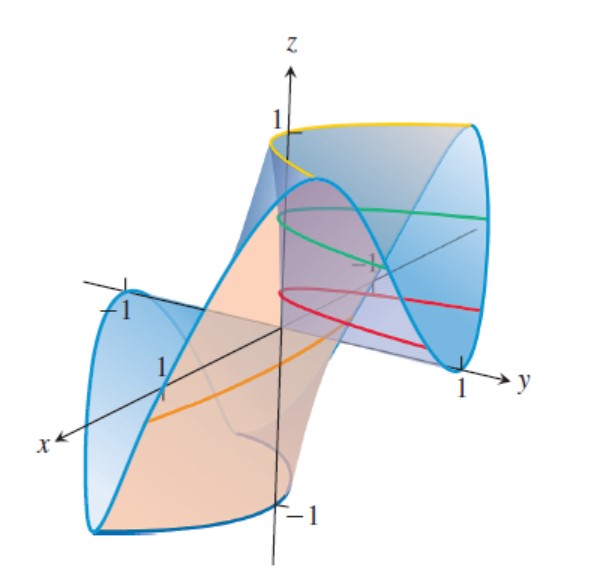
( fig 14.14,
fig 14.15).
Two path Theorem. Composition of continuous functions.
Lecture 14 (20240411, 90 mins) (v03: page 1, 6 corrected)
Section 14.3: Partial derivatives. Implicit partial differentiation. Higher order partial derivatives.
Definition of differentiability; Further explanation of tangency of two curves in a plane.
Homework 07 (lectures 13)
Homework 07 solutions.
Homework 08 (lectures 14-15)
Homework 08 solutions (new: page 3 corrected to "Mean Value
Theorem").
- Week 09: Quiz 06 (Section 14.2: Apr 16, 10:10AM).
Lecture 15 (20240416, 75 mins) (v02: added remark on page 1)
Section 14.3:
Equivalent Definitions of differentiability.
Further explanation of tangency of two surfaces in space.
Theorem 2: Continuity of second partial derivatives implies interchanging
order of two partial derivatives and a counter example.
Theorem 3: Sufficient condition of differentiability in terms of continuity of first partial derivatives
and a counter example.
Theorem 4: Differentiability implies continuity. Proof.
Lecture 16 (20240418, 90 mins)
Section 14.4:
Application of differentiability to the Chain rule. Examples of the chain rule.
Implicit partial differentiation revisited;
Section 14.5:
Definition and examples of directional derivative.
Theorem 9: Differentiability leads to formula of directional derivative.
Homework 09 (lectures 16-17)
Homework 09 solutions.
- Week 10: Quiz 07 (Section 14.3: Apr 23, 10:10AM).
Lecture 17 (20240423, 75 mins)
Section 14.4:
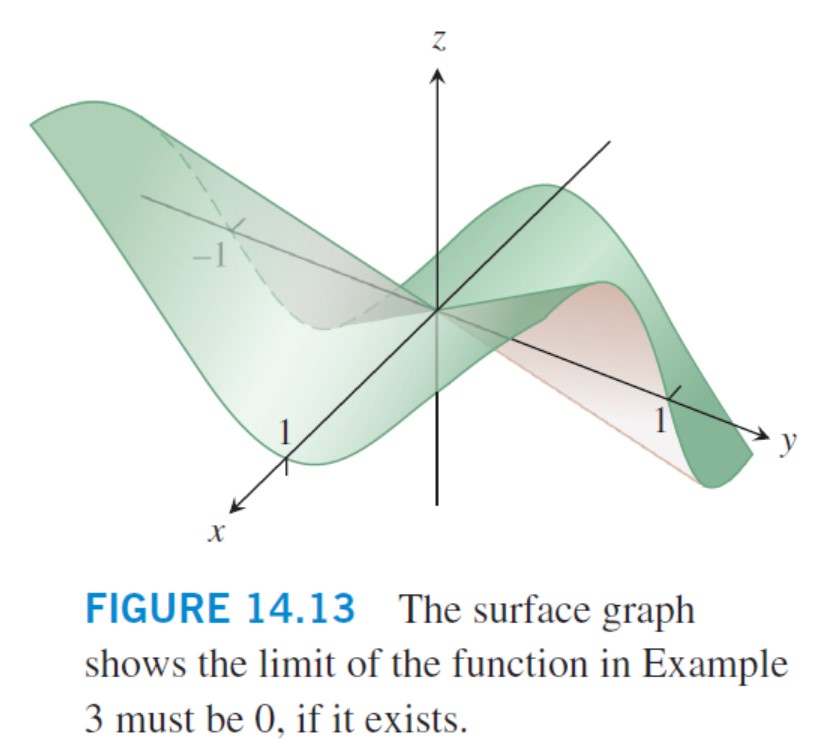
Relation between gradient vector and directional derivatives. Example and counter example
(fig 14.13).
Section 14.5:
Properties of ∇f.
Finding tangent and normal lines of a level curve of F(x,y)
using the gradient vector ∇F.
Lecture 18 (20240425, 80 mins)
Section 14.6:
Find tangent plane and normal line of a level surface of F(x,y,z).
Find tangent line and normal plane of a curve in space.
Linear approximation of z=f(x,y) near (x0,y0,z0).
Linear approximation = tangent plane.
Error estimate for Linear Approximation.
Homework 10 (lectures 18-19) (update: added hint for Section
14.7, problems 31, 35.
Homework 10 solutions.
- Week 11: Quiz 08 (Section 14.4-14.5: Apr 30, 10:10AM).
Lecture 19 (20240430, 70 mins)
Section 14.7:
First Derivative Test for local extremes.
Definition of critical points.
Second Derivative Test, Proof and Example.
Introduction of "gradient analysis" as a (better) alternative to Second Derivative Test.
Lecture 20 (20240502, 80 mins)
Section 14.7:
Find absolute extremes on a bounded region using gradient analysis.
Section 14.8:
Constrained Optimization: Method of Lagrangian Multiplier.
Example: Optimize a function of two variables with one constraint.
Homework 11 (lectures 20-21)
Homework 11 solutions.
- Week 12: Quiz 09 (Section 14.6-14.7: May 07, 10:10AM).
Lecture 21 (20240507, 75 mins)
Section 14.8:
Example: Optimize a function of three variables with one constraint.
Example: Optimize a function of three variables with two constraints. Example.
Section 14.9:
Derivation of Taylor's formula for functions of two variables.
Lecture 22 (20240509, 40 mins)
Section 14.9:
- Generalization to functions of three or more variables.
- Applications: Error estimate for linearization,
validity of Second Derivative Test for local extremes.
- Week 13: Midterm 02 (Section 14.2-14.9 + Content of Midterm 01, May 14, 10:10AM).
Remark on definition of differentiability
Lecture 23 (20240516, 70 mins)
Section 14.10:
- Partial Derivatives with Constrained variables.
Explain the notation and how to compute. Examples.
No recitation this week.
Homework 12 (lectures 23-24 + page 1-3 of Lecture 25)
Homework 12 solutions.
- Week 14: No Quiz this week.
Lecture 24 (20240521, 75 mins)
Section 15.1:
-
Double integrals defined as limit of Riemann sum.
Section 15.2:
-
Fubini's Theorem and iterated integrals on rectangular regions.
-
Fubini's Theorem (strong form) and iterated integrals on rectangular-like regions.
Section 15.3:
-
Area by double integrals (special case of section 15.2).
Lecture 25 (20240523, 95 mins)
Section 15.2-15.3:
-
Interchanging order of integration for double (iterated) integrals.
Section 15.4:
-
Integration in polar form. Derivation of dA = r dr dθ.
-
Examples on identifying limits of
integration for dA = r dr dθ and = dθ r dr, respectively.
Homework 13 (lectures 25-26)
Homework 13 solutions.
- Week 15: Quiz 10 (Section 14.10, 15.1-15.2, May 28, 10:10AM).
Lecture 26 (20240528, 70 mins)
Section 15.5:
-
Triple Integrals. Definition. Method of identifying limits of integration for
various choice of dV = dz dy dx, or dy dz dx, etc.
Section 15.7:
-
Triple Integrals in Cylindrical Coordinates. Definition.
dV = dA dz = r dr dθ dz.
Lecture 27 (20240530, 70 mins using slides)
Section 15.7:
Method of identifying limits of integration for
various choice of order in dV = r dr dθ dz, dθ r dr dz, etc.
Triple Integrals in Spherical Coordinates.
Method of identifying limits of integration for
various choice of order in dV = ρ^2 sinφ dρ dθ dφ.
Homework 14 (lectures 27-28)
Homework 14 solutions.
- Week 16: Quiz 11 (Section 15.4-15.5, June 04, 10:10AM).
Lecture 28 (20240604, 60 mins using slides)
Section 15.8:
Substitution in Multiple Integrals: Formula of Jacobian for double integrals.
Deriving the formula of Jacobian for double and triple integrals. Examples.
Section 16.1:
Definition of line integrals as limit of Riemann sum.
Scalar line integrals by means of parametrization of the curve.
Remark on independence of the choice for parametrization of the curve.
Lecture 29 (20240606, 100 mins)
Section 16.1:
Examples of computating scalar line integrals by means of parametrization of the curve.
Section 16.2:
Notation and computation of Work done along the path
Relevence of of correctly oriented parametrization of the curve
Introduction of simple closed curves.
Notation of circulation and flux over a simple closed curve. Examples.
Section 16.3:
Fundamental Theorem of Line Integrals. Theorem, proof and application.
Definition of Simply Connected regions. Examples in 2D and 3D Eucledian spaces.
Homework 15 (lectures 29-30)
Homework 15 solutions.
- Week 17: Quiz 12 (Section 15.7-15.8, June 11, 10:10AM).
Lecture 30 (20240611, 55 mins. The last lecture.)
Section 16.3:
Definition of conservative fields
Theorem 1 (stated without proof): gradient vector fields are conservative.
Theorem 2 (stated without proof): condervative vector fields are gradients.
Theorem 3 Equivalence of conservative fields
and vector fields satisfying the loop property.
Necessary condition for conservative fields: Component test. 2D and 3D. Examples.
Theory and examples on construction of potential function for conservative fields.
Example on how to find potential function for closed fields (those satisfying the
component test) on simply connected domains.
- Week 18: Final Exam (Section 14.10-16.3, Jun 18, 10:10AM).
Note on Conservative Fields and Simply Connected Domains.
- Homework assignments of this semester (temporary):
Chapter 10.
Chapter 14.
Chapter 15.
Chapter 16.